
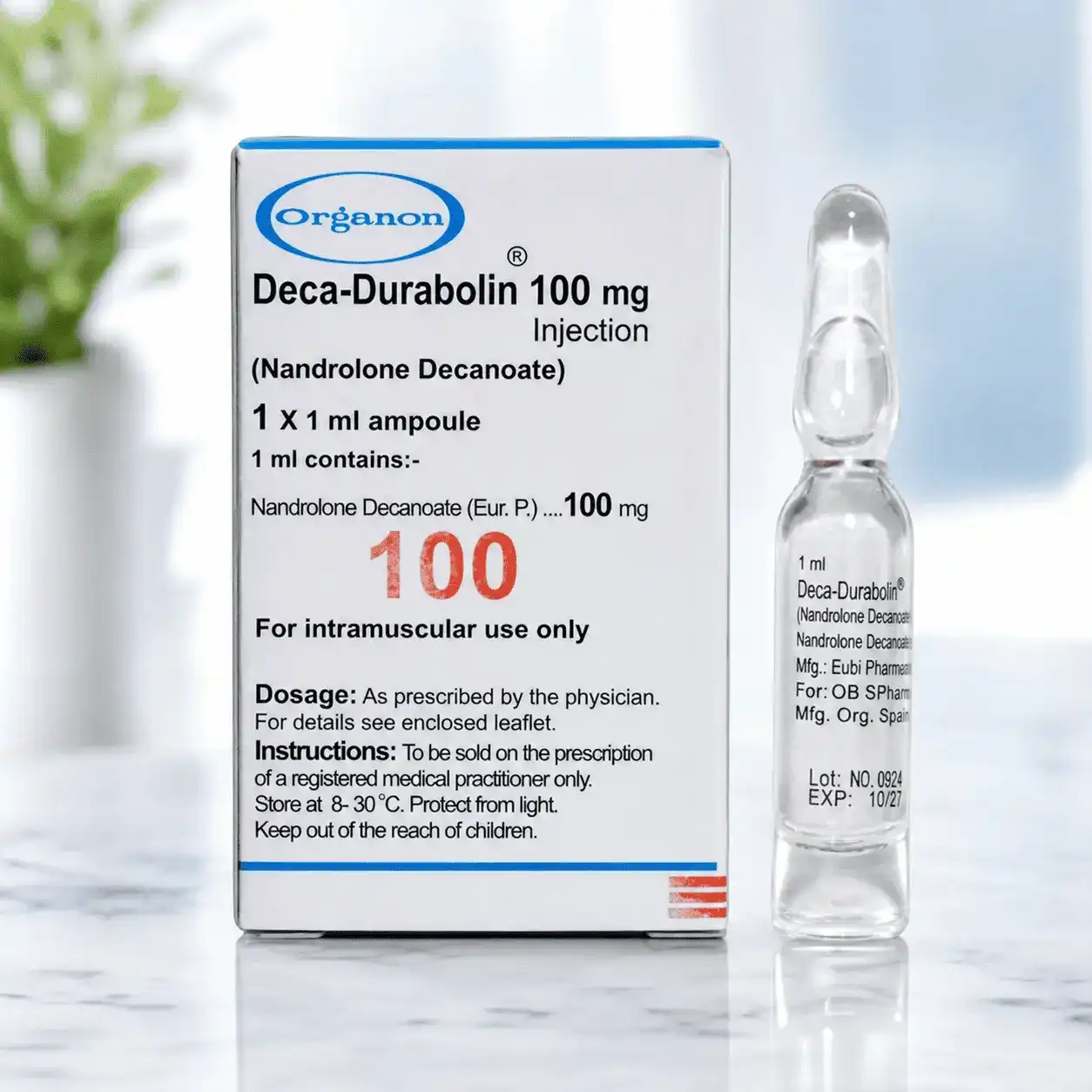
Deca-Durabolin is the original brand name for nandrolone decanoate, first introduced by the Dutch company Organon in 1962. Today it is sold under several brand and generic names worldwide, although availability differs from country to country. In the United States the original brand has been discontinued, while generic versions and other brands remain in use in parts of Europe, Asia and Latin America.
It belongs to a drug class called anabolic-androgenic steroids (AAS). These are man-made relatives of testosterone. "Anabolic" refers to tissue building (muscle, bone, red blood cells), and "androgenic" refers to male characteristics (facial hair, deep voice). Nandrolone is valued in medicine because it leans strongly toward the anabolic side.
|
Property |
Detail |
|
Generic name |
Nandrolone decanoate |
|
Chemical name |
19-nortestosterone 17β-decanoate |
|
Molecular formula |
C28H44O3 |
|
Molecular weight |
about 428.6 g/mol |
|
Drug class |
Anabolic-androgenic steroid |
|
Form |
Clear, oily solution for intramuscular injection |
|
Common strengths |
25 mg/mL, 50 mg/mL, 100 mg/mL, 200 mg/mL (varies by country) |
|
Typical oil base |
Arachis (peanut) oil, with benzyl alcohol as a preservative |
|
Prescription status |
Prescription only; controlled substance in many countries |
The name "19-nor" tells you the key structural difference. Nandrolone is testosterone without the carbon atom at position 19. That small change makes it more anabolic and less androgenic than testosterone.
The decanoate part is a 10-carbon fatty acid chain (an ester) attached to the hormone. It makes the drug dissolve in oil and release slowly from the injection site. Once in the bloodstream, enzymes cut off the ester, leaving active nandrolone. Because of this slow release, the decanoate form has an effective half-life of roughly 6 to 12 days. That is why injections are spaced out by a week or more instead of being given daily.
Nandrolone works by binding to androgen receptors inside cells, especially in muscle, bone and bone marrow. Once it attaches, the receptor moves into the cell nucleus and switches on genes that drive growth and repair. In practical terms, this leads to several effects.
1. More protein building. Muscle cells make more protein and break down less of it. The body holds on to more nitrogen, a sign that it is in a "building" state rather than a "breaking down" state.
2. More red blood cells. Nandrolone stimulates the kidneys to release more erythropoietin (EPO) and acts directly on bone marrow. This raises hemoglobin and helps correct some types of anemia.
3. Stronger bones. It increases calcium retention and bone mineral density, which is why it has been used in osteoporosis.
4. Better appetite and weight gain. Many patients with chronic illness notice improved appetite and a gradual return of lean weight.
5. Possible joint and connective tissue effects. Nandrolone may increase collagen production. This is often mentioned in sports circles, but the medical evidence is limited.
In tissues like skin, scalp and prostate, testosterone is converted by the enzyme 5-alpha reductase into DHT, a much stronger androgen. Nandrolone goes through the same enzyme but turns into dihydronandrolone (DHN), which is actually weaker. This is the main reason nandrolone tends to cause less acne, oily skin and hair loss than testosterone at comparable doses.
Nandrolone also converts to estrogen at a lower rate than testosterone. However, it has progestogenic activity, meaning it can act a bit like the hormone progesterone. This can raise prolactin and contribute to breast tissue growth or sexual side effects in some men.
After an injection, blood levels rise over a day or two and then fall slowly over the following weeks. Its breakdown products, mainly 19-norandrosterone, can show up in urine tests for many months after the last dose. This long detection window is one reason nandrolone is among the most frequently reported substances in sports doping cases.
Approved uses vary by country, and some older indications have been dropped as newer treatments arrived. The most recognized medical uses are listed below.
|
Medical use |
Why it helps |
|
Anemia of chronic kidney disease (renal insufficiency) |
Raises red blood cell production and hemoglobin |
|
Postmenopausal osteoporosis (in some countries) |
Increases bone mineral density, may reduce bone pain |
|
Muscle wasting in chronic illness (for example HIV-related wasting, cancer cachexia) |
Helps rebuild lean body mass and appetite |
|
Recovery after major surgery, burns or trauma (off-label in some places) |
Supports protein building and healing |
|
Certain aplastic or refractory anemias (specialist use) |
Stimulates bone marrow |
Today, drugs such as erythropoietin-stimulating agents have largely replaced nandrolone for kidney-related anemia in wealthy countries. Even so, nandrolone is still used where those drugs are unavailable or too costly, and in research on muscle wasting.
Deca-Durabolin is for adults with a specific medical diagnosis who are under regular follow-up by a doctor. Typical patients include:
Deca-Durabolin is given as a deep intramuscular injection, usually into the upper outer part of the buttock (gluteal muscle). It is normally given by a nurse or doctor, or by a trained patient at home under clear instructions. It is never injected into a vein.
The dose depends on the condition, body weight, kidney function and how the patient responds. The ranges below come from official prescribing information and are shown only to explain how the medicine is used clinically. Your doctor's dose is the one that counts.
|
Condition |
Usual adult dose (prescribing information) |
|
Anemia of kidney disease, women |
50–100 mg once a week |
|
Anemia of kidney disease, men |
100–200 mg once a week |
|
Postmenopausal osteoporosis (where approved) |
50 mg every 3 weeks |
Treatment for anemia usually runs for a set course, often up to 12 weeks, after which the doctor checks blood counts and decides whether to pause or continue. Use in children is rare and limited to specialists because of the risk to growth.
Before starting Deca-Durabolin, tell your doctor about every health condition you have and every medicine or supplement you take. Extra care is needed in the following situations.
|
Medicine |
Possible effect |
|
Warfarin and other blood thinners |
Stronger anticoagulant effect, higher bleeding risk |
|
Insulin and diabetes tablets |
Lower blood sugar |
|
Corticosteroids or ACTH |
More swelling and fluid retention |
|
Other anabolic steroids or testosterone |
Added hormonal and heart risks |
Nandrolone is banned at all times by the World Anti-Doping Agency (WADA). Athletes who need it for a genuine medical reason must apply for a Therapeutic Use Exemption before using it.
Like every medicine, Deca-Durabolin can cause side effects, although not everyone gets them. Most are linked to dose and length of use: higher doses for longer periods carry much greater risk. This is a big reason why non-medical use, where doses are often many times higher than prescribed, is dangerous.
Women are especially sensitive to the masculinizing effects. Some of these can be permanent, even after stopping.
A woman who notices any change in her voice should contact her doctor right away, because early action may prevent lasting change.
Seek medical help urgently if you notice any of these:
Rare liver problems such as blood-filled cysts (peliosis hepatis) and liver tumors have been reported with long-term anabolic steroid use. These are less common with injectable nandrolone than with oral steroids, but they are not impossible.
People who use nandrolone without a prescription, often combined with other steroids, face higher risks of heart enlargement, heart attack, infertility, dependence, and withdrawal symptoms such as depression and fatigue when they stop. Products bought illegally are also frequently fake, under-dosed or contaminated.
Laws change, so check the current rules in your country before travelling with or ordering any steroid medicine.
It is mainly used to treat anemia caused by kidney disease, some cases of postmenopausal osteoporosis, and serious muscle or weight loss caused by chronic illness.
Yes. It is an anabolic-androgenic steroid made from testosterone. It is not the same as corticosteroids like prednisone, which are used for inflammation.
Patients often notice better appetite and energy within 2 to 4 weeks. Changes in hemoglobin usually take 4 to 8 weeks, and bone density changes take months.
Most medical schedules use one injection every 1 to 3 weeks, depending on the condition and dose.
Yes, but only under close medical supervision and at low doses, because women can develop permanent masculine features such as a deeper voice.
No. Using it to build muscle without a medical need is illegal in many countries and carries serious risks to the heart, hormones, fertility and mental health.
Injectable nandrolone is less toxic to the liver than oral steroids, but liver problems can still occur, especially with high doses or long use. Doctors monitor liver tests during treatment.
It may increase collagen and fluid retention, which some users feel eases joint discomfort. There is no strong clinical evidence that it treats joint disease, and it is not approved for this.
In men, it lowers sperm production. This usually improves after stopping, but recovery can take months and is not guaranteed after long, high-dose use.
Its metabolites can be detected in urine for many months, and in some cases more than a year after the last injection.
Both contain nandrolone. Deca-Durabolin uses the long-acting decanoate ester, while Durabolin uses the shorter phenylpropionate ester, which needs more frequent injections.
Moderate alcohol is not known to interact directly, but alcohol adds strain to the liver and heart. Ask your doctor what is safe for you.