
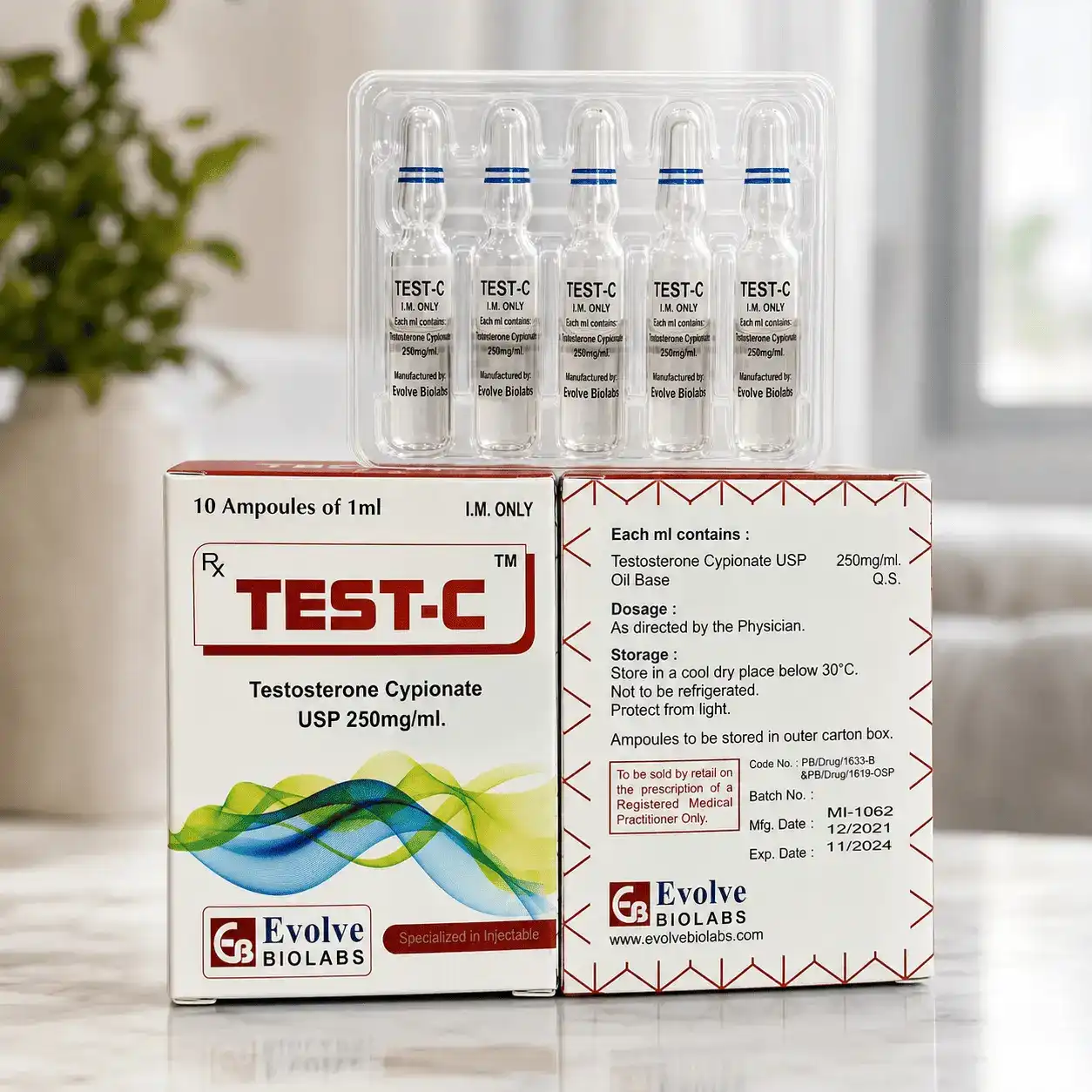
Testosterone cypionate is natural testosterone with a fatty-acid "tail" attached, which lets it be stored in oil and released slowly after injection. It was introduced by Upjohn (now part of Pfizer) in the early 1950s and remains a first-line testosterone replacement therapy (TRT) worldwide. Generic versions are widely available.
It belongs to the androgen class of hormones. Unlike synthetic anabolic steroids such as nandrolone or stanozolol, the active hormone it releases is chemically identical to the testosterone the body makes on its own.
|
Property |
Detail |
|
Generic name |
Testosterone cypionate |
|
Common brand names |
Depo-Testosterone, Azmiro, plus many generics |
|
Chemical name |
Testosterone 17β-cyclopentylpropionate |
|
Molecular formula |
C27H40O3 |
|
Molecular weight |
about 412.6 g/mol |
|
Drug class |
Androgen (testosterone ester) |
|
Form |
Clear, pale yellow oily solution for intramuscular injection |
|
Common strengths |
100 mg/mL and 200 mg/mL |
|
Typical oil base |
Cottonseed oil, with benzyl benzoate and benzyl alcohol |
|
Half-life |
About 8 days |
|
Prescription status |
Prescription only; controlled substance in many countries |
The cypionate ester (cyclopentylpropionate) is an 8-carbon chain attached at the 17-beta position. After injection, enzymes in the blood gradually cut the ester off, freeing active testosterone. Cypionate behaves almost the same as testosterone enanthate, its closest cousin, and the two are often used interchangeably.
Because the solution contains cottonseed oil, people with a cottonseed allergy need a different product.
Once the ester is removed, the freed testosterone acts exactly like the hormone the testes produce. It works through three main routes.
The "peaks and troughs" pattern
After an injection, testosterone levels rise over 2 to 3 days to a peak, often above the normal range, and then fall slowly. By the end of a 2-week interval they may drop to the low-normal range or below. Some patients feel this as a burst of energy after the shot and fatigue or low mood before the next one. Doctors often deal with this by using smaller doses more often, such as once a week.
The brain senses the incoming testosterone and reduces the signals (LH and FSH) that tell the testes to work. Over time the testes make less of their own testosterone and far fewer sperm. This is why TRT usually lowers fertility.
|
Medical use |
Why it helps |
|
Primary hypogonadism (testicular failure from genetic conditions such as Klinefelter syndrome, injury, chemotherapy, orchitis, or removal of the testes) |
Replaces hormone the testes cannot make |
|
Secondary hypogonadism (pituitary or hypothalamus problems, tumors, injury) |
Replaces hormone when the brain's signal to the testes fails |
|
Delayed puberty in boys (specialist use) |
Starts puberty changes in a controlled way |
|
Gender-affirming hormone therapy for transgender men and nonbinary people (off-label in many countries) |
Develops masculine characteristics |
US regulators have stated that testosterone is not approved simply for the natural age-related decline in testosterone, without a clear underlying medical cause.
Testosterone cypionate is for people with a confirmed diagnosis of low testosterone. Most guidelines require:
Testosterone cypionate is given as an intramuscular injection, usually into the buttock (gluteal muscle) or the outer thigh (vastus lateralis). Many patients learn to inject themselves at home after training from a nurse. Some clinicians also prescribe it under the skin (subcutaneously) in small weekly doses, although this is off-label for most products. It must never be injected into a vein.
The ranges below come from official prescribing information and are shown only to explain medical use. Your doctor sets your dose based on symptoms and blood tests.
|
Use |
Usual dose (prescribing information) |
|
Male hypogonadism (adults) |
50–400 mg every 2 to 4 weeks |
|
Common real-world TRT schedule |
Often 100–200 mg every 2 weeks, or a smaller dose weekly |
|
Delayed puberty |
Lower doses for a limited time, set by a pediatric specialist |
The goal is to keep testosterone in the normal range, not above it. Doctors usually check a blood level midway between injections and adjust the dose or interval.
Tell your doctor about all your health conditions and every medicine or supplement you take before you start. Extra care is needed in these situations.
|
When |
What is checked |
|
Before starting |
Testosterone (2 morning tests), hematocrit, PSA (men over 40), lipids, sometimes LH/FSH |
|
3–6 months |
Testosterone level, hematocrit, PSA, blood pressure, symptom review |
|
Every 12 months after |
The same tests if stable |
|
Medicine |
Possible effect |
|
Warfarin and other blood thinners |
Stronger effect; bleeding risk |
|
Insulin and diabetes medicines |
Lower blood sugar; doses may need reducing |
|
Corticosteroids |
More fluid retention |
|
Ciclosporin |
Changes in drug levels |
|
Other anabolic steroids |
Added hormonal and heart risks |
Testosterone is banned at all times by the World Anti-Doping Agency (WADA). Athletes with diagnosed hypogonadism must obtain a Therapeutic Use Exemption.
Most men on properly dosed TRT tolerate it well, but side effects are possible and become more likely at higher doses.
Doctors usually manage these first by adjusting the dose or spacing injections, rather than adding extra drugs.
When used for gender-affirming care, these are often the intended effects. Some are permanent:
Get urgent medical help for:
At the high doses used in bodybuilding, often several times a replacement dose, the risks of heart muscle thickening, high blood pressure, thick blood, infertility, aggression and dependence rise sharply. Stopping after long misuse can leave natural testosterone production suppressed for months, causing depression, low libido and fatigue. Black-market products are often contaminated or mislabeled.
Laws vary and change, so check your local rules before buying, importing or travelling with testosterone.
It treats men with low testosterone caused by problems in the testes, pituitary gland or hypothalamus. It is also used for delayed puberty and in gender-affirming care.
Sex drive and energy often improve within 3 to 6 weeks. Mood improves over a few weeks to months, while muscle, fat and bone changes take 3 to 12 months or longer.
Most doctors prescribe it every 1 to 2 weeks. Longer gaps of 3 to 4 weeks are allowed by the label but cause bigger swings in hormone levels.
They are very similar. Cypionate has a slightly longer ester and is more common in the US, while enanthate is more common in Europe. Both are usually dosed the same way.
Many clinicians use small weekly subcutaneous doses, and studies show they work well. However, this is off-label for most cypionate products, so only do it if your doctor advises.
It often lowers sperm production significantly, sometimes to zero. Fertility usually returns after stopping, but it can take months. Discuss fertility plans before starting.
Current evidence does not show that normal-range testosterone causes prostate cancer, but it can make an existing cancer grow. That is why PSA is checked.
Yes, in men genetically prone to male-pattern baldness, because some testosterone is turned into DHT.
In men with confirmed low testosterone, the TRAVERSE trial found no rise in heart attacks or strokes, but more atrial fibrillation and blood clots. Your doctor will weigh your personal risks.
Your levels will drop back to where they were or lower, and symptoms usually return. Natural production may take weeks to months to recover. Stop only with your doctor's guidance.
Yes. Testosterone is the body's natural anabolic-androgenic steroid. Medically, TRT replaces a missing hormone rather than adding extra.
Moderate alcohol is generally fine, but heavy drinking lowers testosterone and adds strain to the liver and heart.