
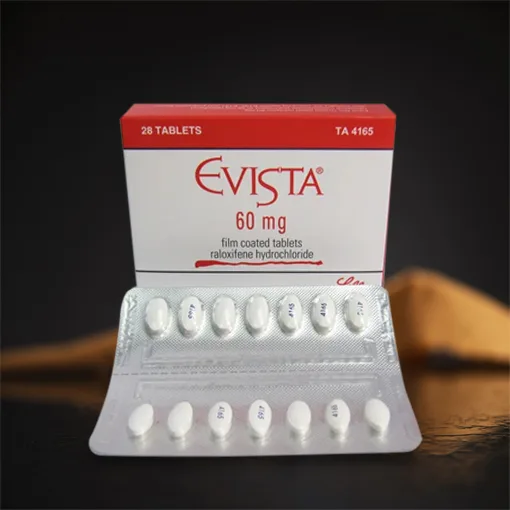
Raloxifene was developed by Eli Lilly. The US FDA approved it in 1997 for preventing osteoporosis in postmenopausal women, later for treating it, and in 2007 for reducing the risk of invasive breast cancer. It is now widely available as a low-cost generic.
Raloxifene belongs to a group of medicines called selective estrogen receptor modulators (SERMs), the same family as tamoxifen and clomiphene. It is not a hormone, not hormone replacement therapy (HRT) and not a steroid. It is sometimes described as a "designer estrogen" because it was built to keep estrogen's benefits for bone while avoiding its effects on breast and womb.
|
Property |
Detail |
|
Generic name |
Raloxifene hydrochloride |
|
Brand names |
Evista, Optruma (in some countries), plus generics |
|
Drug class |
Selective estrogen receptor modulator (SERM) |
|
Chemical family |
Benzothiophene (non-steroidal) |
|
Molecular formula |
C28H27NO4S · HCl |
|
Molecular weight |
about 510 g/mol (hydrochloride); about 474 g/mol (base) |
|
Form |
White film-coated tablet |
|
Strength |
60 mg |
|
Half-life |
About 28 hours |
|
Prescription status |
Prescription only |
Raloxifene's benzothiophene core sets it apart from tamoxifen, which has a triphenylethylene structure. This difference is a key reason raloxifene does not stimulate the lining of the womb the way tamoxifen can.
Only about 2% of a swallowed dose reaches the bloodstream unchanged, because the liver and gut quickly attach sugar-like molecules to it (glucuronidation). The drug then cycles between the gut and liver, which helps explain its long half-life and once-daily dosing.
Estrogen acts through estrogen receptors found in many tissues. After menopause, estrogen falls, and bone loss speeds up. Simply replacing estrogen protects bone but can stimulate breast and womb tissue. Raloxifene gets around this by acting differently depending on the tissue.
|
Tissue |
Raloxifene acts like |
Result |
|
Bone |
Estrogen (agonist) |
Slows bone breakdown, preserves bone density, fewer spine fractures |
|
Blood fats |
Estrogen |
Lowers LDL ("bad") cholesterol |
|
Liver clotting factors |
Estrogen |
Increases clotting tendency, raising risk of blood clots |
|
Breast |
Anti-estrogen antagonist) |
Lowers risk of estrogen receptor-positive breast cancer |
|
Uterus (womb lining) |
Neutral or anti-estrogen |
Does not thicken the lining; no increase in womb cancer |
|
Brain (temperature control) |
Anti-estrogen |
Can trigger or worsen hot flashes |
When raloxifene binds to the estrogen receptor, it changes the receptor's shape in a particular way. Each tissue has its own mix of helper proteins (co-activators and co-repressors) that respond to that shape. In bone, the combination switches estrogen-like genes on; in breast, it switches them off. This tissue-selective behavior is what the "selective" in SERM refers to.
In the large MORE trial of women with osteoporosis, raloxifene reduced the risk of new spine fractures by about 30 to 50% over three years, depending on whether women already had a fracture. It did not significantly reduce hip or other non-spine fractures. In the same and follow-up studies, the risk of invasive breast cancer fell substantially.
In the STAR trial, raloxifene was compared with tamoxifen for breast cancer prevention in high-risk women. Raloxifene was somewhat less effective at preventing invasive breast cancer over the long term, but caused fewer womb cancers, fewer blood clots and fewer cataracts.
|
Approved use |
Details |
|
Treatment of osteoporosis in postmenopausal women |
Lowers the risk of spine (vertebral) fractures |
|
Prevention of osteoporosis in postmenopausal women |
For women with low bone density at risk of developing osteoporosis |
|
Reduction in risk of invasive breast cancer |
In postmenopausal women with osteoporosis, or at high risk of breast cancer |
Raloxifene does not treat existing breast cancer and does not completely remove breast cancer risk. It also has some off-label uses, for example in boys with persistent pubertal breast enlargement (gynecomastia), under specialist care.
For women whose main worry is hip fracture, other medicines such as bisphosphonates or denosumab are usually preferred, because raloxifene has not been shown to protect the hip.
Raloxifene is simple to take: one 60 mg tablet by mouth, once a day, at any time of day, with or without food.
|
Detail |
Standard prescribing information |
|
Dose |
60 mg once daily |
|
How |
Swallow whole with water, with or without food |
|
Time of day |
Any time, but the same time each day |
|
Duration |
Long term, reviewed regularly by your doctor (often several years) |
|
Older adults |
No dose change needed |
|
Kidney or liver problems |
Use with caution; not well studied in moderate to severe impairment |
Raloxifene works best when the body has enough building materials for bone. Most women are advised to get enough calcium (from diet and, if needed, supplements) and vitamin D. Your doctor will suggest amounts that suit you.
Raloxifene carries a boxed warning, the most serious kind, for two risks: blood clots in the veins and lungs, and death from stroke in women who have heart disease or are at increased risk of heart problems. Your doctor will weigh these against your benefits before prescribing.
|
When |
What is checked |
|
Before starting |
Bone density (DEXA), clot and stroke risk, breast cancer risk, menopausal status |
|
Every 1–2 years |
Bone density, to see whether treatment is working |
|
Regularly |
Side effects, blood pressure, breast screening, triglycerides if needed |
|
Medicine |
Possible effect |
|
Cholestyramine (and similar bile acid binders) |
Greatly reduces raloxifene absorption; should not be taken together |
|
Warfarin |
May reduce warfarin's effect; INR should be checked when starting or stopping raloxifene |
|
Estrogen or hormone replacement therapy |
Not recommended together; not studied |
|
Levothyroxine |
Absorption may be reduced; take several hours apart |
|
Highly protein-bound drugs (e.g. diazepam, ibuprofen, naproxen) |
Possible interaction; usually minor |
Raloxifene, like other SERMs, is on the World Anti-Doping Agency (WADA) list of hormone and metabolic modulators, banned at all times. Athletes need a Therapeutic Use Exemption for medical use.
Most women take raloxifene without serious problems, but side effects are common, especially in the first months.
Common side effects
|
Problem |
What often helps |
|
Hot flashes |
Usually ease with time; light layered clothing, cool bedroom, avoiding triggers like alcohol and spicy food |
|
Leg cramps |
Gentle calf stretches before bed, staying hydrated; tell your doctor if severe |
|
Swelling |
Raising the legs, moving regularly; report sudden or one-sided swelling at once |
Get emergency help right away for:
Compared with HRT, raloxifene does not stimulate the breast or womb and does not relieve menopause symptoms (it can worsen hot flashes). Compared with tamoxifen, it causes fewer womb cancers and clots. Compared with bisphosphonates, it does not protect the hip as well but adds breast cancer risk reduction.
Raloxifene is a prescription-only medicine in the United States, United Kingdom, European Union, India, Australia, Canada and most other countries. It is not a controlled substance. Products sold online "for research" or for bodybuilding are unregulated and may not contain what the label says.
Raloxifene (Evista) is a once-daily 60 mg tablet that helps postmenopausal women in two ways: it protects the spine from osteoporosis fractures and lowers the risk of invasive breast cancer. It does this by acting like estrogen on bone while blocking it in breast and womb tissue. Its main risks, blood clots and, in women with heart disease, fatal stroke, mean it is not right for everyone, and it does not protect the hip as well as some other bone medicines. For the right woman, with calcium, vitamin D, exercise and regular reviews, it is a well-studied and useful option. Talk to your doctor to see whether it fits your health and goals.
It is used by postmenopausal women to treat and prevent osteoporosis and to reduce the risk of invasive breast cancer in women at higher risk.
No. It is a selective estrogen receptor modulator (SERM). It acts like estrogen on bone but blocks estrogen in breast and womb tissue.
No. HRT replaces estrogen and relieves menopause symptoms. Raloxifene does not relieve symptoms like hot flashes and may make them worse.
Bone density changes can be measured after about 1 to 2 years. Fracture risk reduction has been shown within the first few years of treatment.
It has not been shown to significantly reduce hip fractures. It mainly lowers the risk of spine fractures.
Many women take it for several years. Your doctor will review your bone density, breast cancer risk and side effects regularly to decide how long to continue.
Tamoxifen is somewhat more effective and can be used before menopause. Raloxifene is only for postmenopausal women but causes fewer womb cancers and blood clots.
Weight gain is not a common side effect in clinical trials. Swelling from fluid retention can occur in some women.
Surgery and long bed rest raise the risk of blood clots. Stopping raloxifene at least 3 days before, as your doctor advises, helps lower that risk.
It is not approved for men. It is sometimes used off-label by specialists, for example for persistent breast enlargement in adolescent boys.
Some use it to treat breast tissue growth caused by steroids. This is unsupervised off-label use and carries the same clot risks, without the safety checks a doctor would provide.
There is no direct interaction, but heavy drinking weakens bones and increases fall risk. Keeping alcohol low supports your treatment.